Showing posts with label post-structuralism. Show all posts

Monday, March 5, 2012

Project, Group Project


So for the last few weeks, my group and I have been working on our project for our Pop Culture class. As I mentioned in a previous post, our topic is James Bond and in particular, Casino Royale. We’ve met a handful of times before class and communicated through email. We each took a separate concept involved with Bond and went in our own directions with it. I decided to look at Casino Royale, and Bond in particular, through the lens of theory, namely Saussure and Derrida. Today in class, for my part of the presentation, I’ll be discussing how Bond’s views of the world begin very structuralist but by the end of the novel, become post-structuralist.

For my contributions to the group, I helped break the novel down and analyze it as a whole. I helped divide the novel into possible chunks or areas of discussion that we could be interested in exploring. I helped in discussions with connecting and comparing the novel to the 2006 film and also brought up some interesting differences between the many iterations of Bond throughout the years. Other people in the group aided me in some areas of my own topic and I also provided feedback on theirs. During the meetings, we all contributed some ideas and feedback to each topic while also constructing the general form of our presentation as a whole. As I’m not especially proficient in power point creation, I mostly helped there by giving feedback and suggestions on the structure and aesthetics of the power point presentation that the others made. 

Bond initially has no difficulty differentiating between good and evil, hero and villain. His experience in the war, as well as all his training, has made it clear to him that the US and England are the heroes and that, at the very least, the Russians are now the villains. This is very Saussurian in that Bond knows that he and his country (and their allies) are good and since Russia is not an ally, they are clearly evil. He is able to define who the heroes are by comparing them to those who aren’t, and vice versa. However, after being tortured by Le Chiffre, Bond’s view changes dramatically. As he is recovering, he has a very interesting discussion with his French police aide, Mathis. Bond says that when he was younger it was easier to tell the difference between good and evil, but it isn’t so easy anymore. He says that somewhere, Le Chiffre was the hero and Bond was the villain and what Le Chiffre was doing was heroic. He says politics and patriotism and everything have an influence over the previous line of thinking but that he is finding it too difficult to differentiate anymore. Bond’s crisis of identity is so great that he decides to resign rather than try to solve his psychological and ideological dilemma. He finds the line not so easily drawn anymore and seems to be very much a post-structuralist. Bond now thinks in a Derridian fashion in that the terms hero and villain and good and evil don’t really have any meaning anymore because the definition is literally different for every single person and changes for them from one instant to the next, giving the concepts no true and universal truth.

Monday, February 13, 2012

ceci n'est pas un blog

After our class discussion last Monday in regards to modernism, structuralism, and post-modernism, I began to think about what some of the theorists thought about the nature of reality. Nearing the end of class, I said, in order to clarify my own thoughts and un-muddy my mental waters (not near as eloquently or in as much detail, but I paraphrase and elaborate here to make myself look like I know what I'm talking about):

"So structuralists, like Saussure for example, believe that signifiers and signifieds are generally fixed for a period of time. They can change, but usually after at least a brief period of stability. For example, I can define what a cat is and what it isn't by comparing it to an infinite about of objects, and over time the way I define cat can change as my understanding of its relationships with everything else changes. But if I'm looking at it from a post-Modernist or post-structuralist standpoint like Derrida, then there is no stability in regards to the fixed nature of definitions since the relationships themselves are arbitrary -- they can literally change from country to country, day to day, person to person, instant to instant. If what I define a cat as changes, then so does its relationship to dog, and then the definition of dog changes which also alters the definitions of everything else dog is related to. Therefore, there is a constant flux between what is and what isn't, pretty much meaning that, well, there is no meaning to anything."

(I'm a fantastic bore in class)

I felt a little bit as I did when reading Plato's Republic for my Critical Theories class. Plato separates, well pretty much everything, into "the world of ideas" and "the world of appearances".  To Plato, the only reality, the only thing of real true value is the idea -- the concept of furniture, the thought of a statue, the concept of a finely cooked meal. Anything else -- the physical poker table, the tangible statue of David, the corporeal 8 ounce New York strip steak, medium-rare with garlic mashed potatoes and broccoli and cauliflower lightly drizzled with butter and Parmesan cheese -- is just a representation of the idea and is thus inferior. I thought "Then anything and everything around me, including my physical body (shock! horror! surprise?) is simply inferior and flawed beyond appreciation. Even that steak I just drooled over?? Thanks, stupid Plato..."

However, I personally decide not to take such a view as Plato or Derrida. There's no fun in it, it seems rather pessimistic to me. And while I can often be a bit of a harsh cynic, I do always strive to find meaning in all that is around me, most often through humor. This clouding of the nature of reality that Plato and Derrida arouse makes me think of René Magritte, the surrealist painter. In particular, it reminds me of one of his most famous paintings, The Treachery of Images:


This, Magritte says, is not a pipe -- it is merely a representation of a pipe ("Just try to stuff it with tobacco!" he said). And, according to Plato, the arts are twice removed from reality, making them even more inferior. So this "pipe" is, at minimum, three-times removed from our reality. Ironically, this is one of Magritte's most famous paintings. What a hack.

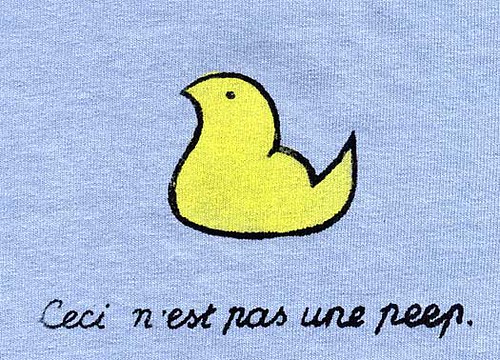
Of course, this image has been co-opted by the generations that followed it, producing and re-producing and so on. Treachery has even found its way onto t-shirts, including some that poke fun at it:


It makes me wonder what post-structuralists would say when I asked them why it took so long for the meaning and definition of Magritte's message to be interpreted on a shirt that that would likely be found at Hot Topic. What do you say to that, Derrida?


Now, to enjoy my flawed steak. Stupid Plato...